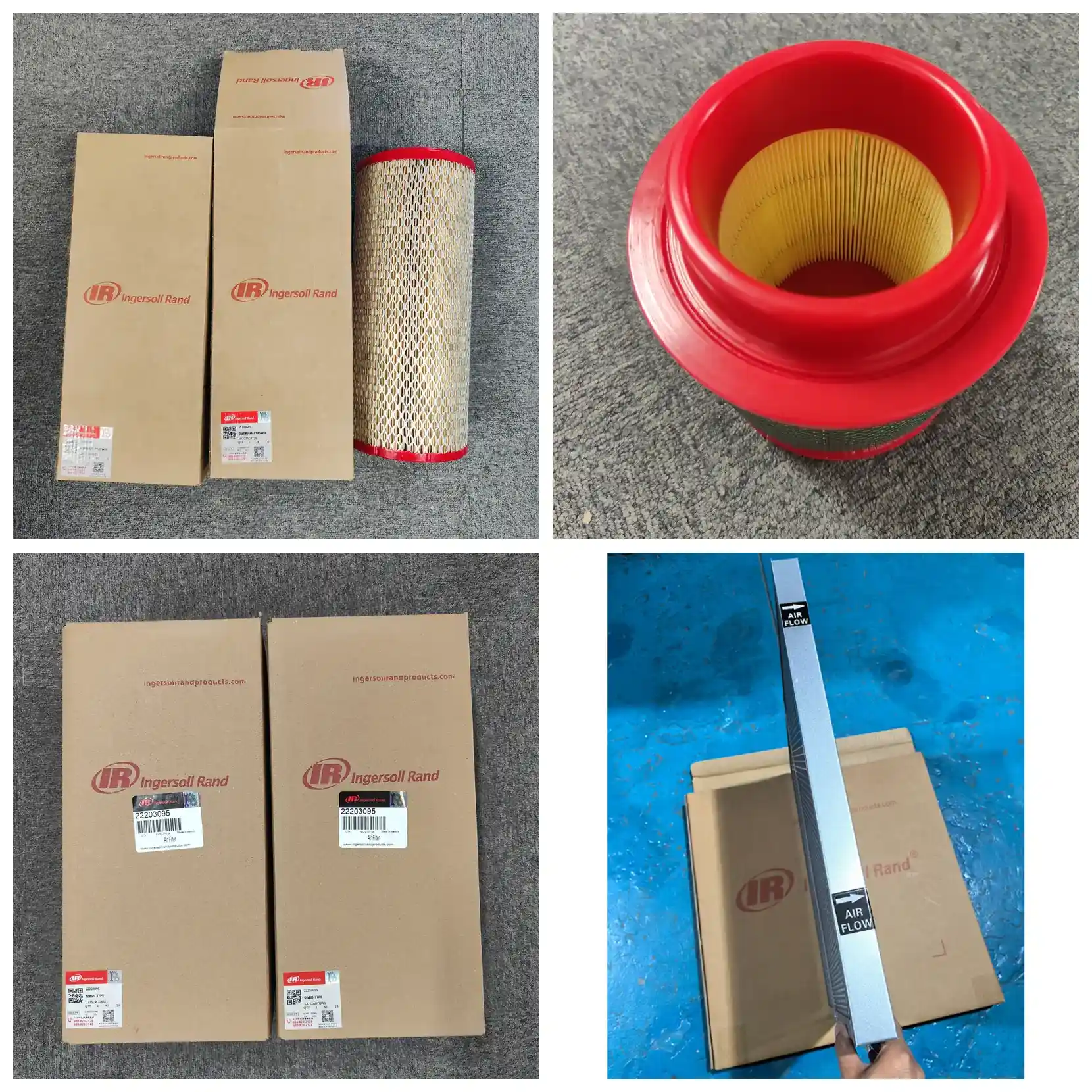
Product
Ingersoll Rand 49164395 Air Filter Element | Donaldson FPG10 RadialSeal
Ingersoll Rand 49164395 air filter element, built to Donaldson FPG10 two-stage RadialSeal specifications. 208 mm OD × 106 mm ID × 409 mm length, 99.9% filtration efficiency (ISO 5011), no gasket, tool-free service. Export-ready with OEM/ODM support and full documentation.
- Export packaging & documentation support
- OEM / ODM customization available
- Sample and bulk order workflow
Product Overview
49164395 is the intake air filter element used on Ingersoll Rand screw air compressors, manufactured to Donaldson FPG10 specifications.
The structural difference from a conventional single-stage air filter is worth clarifying first: FPG10 is a two-stage intake filtration system. Air first passes through an integrated tangential pre-cleaner — the airflow enters tangentially and spins at high speed, centrifugal force throws coarse particles against the housing wall, and approximately 85% of coarse dust is separated before reaching the primary element, then discharged automatically through the Vacuator dust ejection valve at the base of the housing. Pre-cleaned air then enters the primary element, where cellulose filter media performs fine filtration. The value of this architecture is most evident in dusty environments: the primary element carries only the fine-particle load, maintaining longer service life even under high dust conditions.
The sealing method also differs from conventional air filters. FPG uses Donaldson's RadialSeal technology: a one-piece molded polyurethane end cap forms a radial seal directly against the housing outlet tube, eliminating the glued gasket of older axial elements. Fewer parts means fewer failure points — gasket aging, detachment, and installation misalignment are eliminated in the FPG design, and service requires no tools.
Core Specifications
| Item | Value |
|---|---|
| Part Number | 49164395 |
| Name | Air Filter Element |
| Brand | Ingersoll Rand |
| Specification Source | Donaldson FPG10 (two-stage RadialSeal) |
| Role in Assembly | Primary Element |
| Dimensions | 208 mm OD × 106 mm ID × 409 mm length |
| Sealing | RadialSeal (polyurethane end cap radial seal, no gasket) |
| Net Weight | Approx. 1.88 kg |
| Filtration Efficiency | 99.9% (ISO 5011) |
| Pre-Cleaner Efficiency | Up to 85% coarse dust removal |
| Rated Intake Flow | ≤346 cfm / 9.8 m³/min |
| Recommended Replacement Interval | 2000 hours or 3 months |
Technical Parameters
1. Filtration Performance
| Parameter | Value / Notes |
|---|---|
| Filtration Rating | 5 μm class (primary element) |
| Filtration Efficiency | 99.9% (per ISO 5011) |
| Pre-Cleaner Efficiency | Up to 85% coarse dust removal (tangential pre-cleaner stage) |
| Filter Class | Two-stage: first-stage centrifugal pre-cleaner + second-stage cellulose primary element; not classified under EN 779 HVAC filter standards |
| Dust Holding Capacity | Approx. 1200 g |
Practical difference of the two-stage design: A single-stage air filter's media must handle both coarse and fine particles, causing rapid surface loading, faster restriction rise, and shorter life. By transferring the coarse dust burden to the centrifugal pre-cleaner stage, FPG10 significantly improves the primary element's loading profile — a key reason it is widely adopted on construction machinery and generator sets operating in dusty conditions.
2. Flow and Restriction Parameters
| Parameter | Value / Notes |
|---|---|
| Rated Air Flow | ≤346 cfm / 9.8 m³/min (air cleaner assembly rated intake flow) |
| Filtration Face Velocity | Approx. 0.038 m/s |
| Initial Pressure Drop | Approx. 0.5–1.0 kPa (approx. 50–100 mmH₂O) |
| Operating Differential Range | From new-element initial restriction to clogging alarm value |
| Alarm / Final Restriction | Per the unit's intake restriction indicator (yellow/red zone) |
| Restriction vs. Energy | Each 1 kPa increase in intake restriction raises unit energy consumption by approx. 1% |
Restriction and energy consumption: Rising intake restriction reduces intake pressure and density; the unit must work harder to maintain set discharge pressure and flow, increasing specific power. Based on theoretical compression ratio calculations at 0.7 MPa discharge pressure and 101.3 kPa atmospheric pressure:
| Intake Restriction | Compression Ratio | Relative Energy Increase |
|---|---|---|
| 0 kPa (new element) | 7.91 | Baseline |
| 2 kPa | 8.07 | +2.0% |
| 4 kPa | 8.24 | +4.1% |
| 6 kPa | 8.41 | +6.3% |
Engineering implication: As the element goes from new to heavily clogged (0 → 6 kPa), unit energy consumption rises by approximately 6%. The cumulative electricity cost typically far exceeds the price of one filter element — which is why the original FPG10 air cleaner housing includes a restriction indicator port: replacement timing should be determined by actual restriction, not calendar estimates.
3. Structural and Installation Parameters
| Parameter | Value / Notes |
|---|---|
| Dimensions | 208 mm OD × 106 mm ID × 409 mm length |
| Configuration | Pleated cylindrical element, two-stage RadialSeal primary element |
| Effective Filtration Area | Approx. 4.3 m² |
| Pleat Count | Approx. 103 pleats |
| Pleat Spacing | Approx. 4.8 mm |
| Mounting Interface | Radial push-in; end cap seals against housing outlet tube |
| Sealing | RadialSeal — one-piece molded polyurethane end cap forms radial seal directly, no separate gasket |
| Companion Element | Safety element, installed inside the primary element as backup protection |
Procurement note: When verifying replacement parts, compare all three dimensions — 208 mm OD, 106 mm ID, 409 mm length. The FPG design uses radial sealing; push in until the end cap contacts the outlet tube, with no additional gasket required. Do not attempt to add a gasket — it will compromise the radial seal fit.
4. Material Construction
| Parameter | Value / Notes |
|---|---|
| Filter Media | Cellulose filter paper, per FPG10 specification |
| Media Weight | Approx. 130 g/m² |
| Inner/Outer Support | Galvanized steel perforated cage (inner cage + outer screen) |
| End Cap | One-piece molded polyurethane (PU) end cap, encapsulating both media ends and sealing surface |
| Seal | RadialSeal formed by the polyurethane end cap body; no separate O-ring or gasket |
| Bonding | Molded integrally with end cap; no additional adhesive layer |
Construction note: Conventional axial elements consist of three parts — metal end cap, glued gasket, and separate seal ring — any of which can age and cause bypass. FPG encapsulates the end cap, sealing surface, and media ends in a single polyurethane body, reducing part count and improving seal reliability, which is also the basis for its tool-free service.
5. Operating Condition Tolerance
| Parameter | Value / Notes |
|---|---|
| Operating Temperature | Continuous 83 °C |
| Relative Humidity | ≤80% RH, no condensation |
| Burst Strength | Media burst strength approx. 200–400 kPa (per ISO 2758 paper burst test) |
| Collapse Resistance | Element withstands intake alarm differential without collapse (RadialSeal layered support) |
| Special Feature | Two-stage filtration (integrated tangential pre-cleaner) + Vacuator automatic dust ejection valve |
| Housing Characteristics | FPG housing is injection-molded plastic; corrosion-resistant, vibration-resistant |
6. Life and Maintenance Parameters
| Parameter | Value / Notes |
|---|---|
| Service Life | 2000 hours or 3 months, whichever comes first |
| High-Dust Environments | Per restriction indicator reading; schedule replacement when restriction enters yellow zone |
| Shelf Life | Approx. 2–3 years (unopened, dry, ventilated storage) |
7. Applicable Standards
| Item | Details |
|---|---|
| Product Standard | ISO 5011 (Inlet air cleaning equipment for internal combustion engines and compressors — performance testing); efficiency figures measured per this standard |
| Structural Standard | Donaldson FPG / FRG series air cleaner specification (RadialSeal sealing system) |
| Commonly Cited Test Standards | ISO 2941 / 2942 / 2943 / 3723 / 3724 / 3968 |
| Standards Applicability Note | The above ISO 29xx / 37xx series are in fact general test methods for hydraulic fluid power filter elements. If a supplier can only provide hydraulic filter standards, request ISO 5011 or the original specification sheet. |
Standard Maintenance and Installation Steps
A key feature of the FPG design is tool-free maintenance; each service takes approximately 15 minutes.
Shut down, confirm zero pressure, lockout/tagout
Stop the unit, disconnect main power, and apply lockout/tagout. Criterion: controller displays system pressure at 0.Open the FPG air cleaner service cover
Release the service cover latches — the FPG design uses two spring latches or a twist-off cover, requiring no tools. Criterion: latches intact, cover not deformed.Remove the old element
Grip the polyurethane end cap and pull straight out. Criterion: note that the RadialSeal design has no gasket to peel — if a residual gasket is found on the housing outlet tube, a non-genuine part was previously installed and must be cleaned off.Inspect the Vacuator dust ejection valve
Check the Vacuator valve (rubber duckbill valve) at the base of the housing. Criterion: valve opens and closes freely, no dust caking, no obstruction. This step is the most commonly skipped in FPG maintenance and has the most serious consequences — a clogged ejection valve disables the pre-cleaner stage, transferring the entire dust load to the primary element and significantly shortening its life.Inspect the pre-cleaner stage and housing interior for dust traces
Look for dust bypass tracks inside the housing and abnormal accumulation in the pre-cleaner swirl zone. Criterion: no dust tracks on inner walls; if tracks are present, inspect sealing surfaces.Install the new element
Push the 49164395 into the housing until the polyurethane end cap contacts the outlet tube. Criterion: end cap seats fully against the outlet tube; no gasket is needed or permitted.Reinstall the service cover and check the restriction indicator
Refit the service cover and secure the latches. Confirm the intake restriction indicator is in the green zone; if resettable, press to reset and verify it returns properly. Criterion: green zone reading, indicator functions correctly.Start up and record
Start the unit, run to operating temperature, and read intake restriction. Criterion: restriction within the new-element baseline range; record date, running hours, and restriction reading.
Installation rule: Do not start the unit before the element is properly seated. If the RadialSeal is not pushed fully into position, air will bypass directly through the gap between the end cap and outlet tube, rendering both the pre-cleaner stage and primary element ineffective — equivalent to running with no filter at all.
Frequently Asked Questions
What specification is the 49164395?
A two-stage RadialSeal primary element manufactured to Donaldson FPG10 specifications. The integrated tangential pre-cleaner removes approximately 85% of coarse dust first, with the primary element handling fine filtration.
Is it interchangeable with 49101637?
No. 49101637 is FPG09, with different dimensions and rated flow from FPG10. Verification is straightforward: read the specification marking on the currently installed element's end cap — if it reads FPG10, order this part; if FPG09, order 49101637.
Why does this element have no gasket?
Because it uses RadialSeal radial sealing. The polyurethane end cap body forms the seal directly against the housing outlet tube, with no glued gasket or separate seal ring required. Fewer parts, fewer failure points, and less chance of incorrect installation.
What does the Vacuator dust ejection valve do?
It is the dust discharge port of the pre-cleaner stage. Coarse dust separated by the swirling airflow in the pre-cleaner falls by gravity to the housing base and is automatically ejected through the Vacuator valve. Once the valve clogs, the pre-cleaner stage is completely ineffective, and all dust loads the primary element directly. Inspect it at every filter change — this is the critical maintenance action for the FPG design.
How often should it be replaced?
The recommended interval is 2000 hours or 3 months, whichever comes first. More accurately, monitor the intake restriction indicator: schedule replacement when restriction enters the yellow zone. In high-dust environments, replace earlier based on indicator readings.
Can the element be blown clean and reused?
No. This is a dry, disposable element — it cannot be washed or reverse-blown with compressed air. Reverse blowing damages the media fiber structure and creates invisible channels that allow unfiltered air to pass, which is more dangerous than not replacing it at all.
Can a gasket be added to improve sealing?
No, and it is unnecessary. RadialSeal relies on radial compression of the end cap body to form the seal; adding a gasket pushes the element away from the outlet tube, actually compromising the seal fit and causing bypass.
The intake restriction indicator never moves — is that normal?
No. A stuck indicator is a common failure point that can give a "clean" reading when the element is actually clogged. Check it at every service by pressing to verify it returns properly; if it has failed, replace the element on a conservative time-based schedule until the indicator is repaired.
What are the pros and cons of the FPG plastic housing versus metal?
The FPG injection-molded housing is corrosion-resistant, lightweight, and vibration-resistant — it will not rust in coastal salt-spray or humid environments. The tool-free service design also speeds up field maintenance. This is why the FPG series is widely used on construction machinery and mobile equipment.
How can I be 100% certain this is the right part?
Three steps: (1) read the specification marking on the currently installed element's end cap to confirm FPG10; (2) measure the old part's outer diameter and length to verify 208 mm and 409 mm; (3) if the old part is discarded, provide the model marking on the air cleaner housing, and we will cross-reference to confirm per FPG specifications.
Compatible Equipment
This part is supplied to Donaldson FPG10 specifications and is suitable for Ingersoll Rand screw air compressors equipped with FPG10 air cleaners.
FPG10 is a Donaldson finished air cleaner assembly specification, adopted by OEMs as a standard intake filtration unit. Key identification points:
| Identification Item | Specification |
|---|---|
| Air Cleaner Specification | Donaldson FPG10 (elements interchangeable with FRG10 series) |
| Air Cleaner Rated Flow | ≤346 cfm / 9.8 m³/min |
| Role in Assembly | Primary Element |
| Other Specification in Series | FPG09 — part number 49101637, different dimensions and flow, not interchangeable |
| Sealing System | RadialSeal (polyurethane end cap radial seal) |
How to confirm compatibility
- Preferred: Read the specification marking on the currently installed element's end cap. If marked FPG10, this part applies; if marked FPG09, order 49101637.
- Alternative: Measure the old part's outer diameter and length to verify 208 mm × 409 mm.
- Fallback: Provide the model marking on the air cleaner housing or a photo of the unit nameplate, and we will cross-reference per FPG specifications.
Note on model coverage: Donaldson FPG10 is a general-purpose air cleaner adopted by multiple OEMs, so this part's compatibility is not strictly limited to a specific list of machine models. The determining factor is whether the air cleaner specification is FPG10, not the machine model itself. If the unit nameplate does not indicate the air cleaner specification, confirm using any of the three methods above.
Related Components
The FPG10 air cleaner is a complete system; besides the primary element, there are 7 components serviced together with this part. Listed below by component — function — inspection point:
| Component | Function | Inspection Point |
|---|---|---|
| Safety Element | Backup element inside the primary element; protects downstream if the primary is damaged or during change intervals | Generally replaced on the same or alternate cycle as the primary; inspect media for damage |
| Vacuator Dust Ejection Valve | Automatic dust discharge port of the pre-cleaner stage; ejects centrifugally separated coarse dust from the housing | Inspect at every filter change: valve must open and close freely, no dust caking, no obstruction |
| Restriction Indicator | Indicates element clogging level; authoritative basis for determining replacement timing | Check that the needle returns properly; connection line must be clear |
| Service Cover and Latches | Tool-free opening/closing structure of the FPG housing | Check latches for cracks, cover for deformation; no air leak when secured |
| FPG Housing Assembly | Injection-molded plastic housing with tangential inlet and pre-cleaner swirl zone | Inspect inner walls for dust bypass tracks; check plastic parts for cracks |
| Intake Hose and Clamps | Connects air cleaner to the engine intake duct | Check for cracks, aging, looseness — bypass leakage is as harmful as running with no filter |
| Other Primary Elements in Series | FPG09 — part number 49101637 | Different dimensions and flow from FPG10, not interchangeable; distinguish when stocking |
Companion replacement recommendation: The maintenance value of the FPG10 system centers on whether the pre-cleaner stage is functioning properly. When changing the primary element, inspect the Vacuator valve and restriction indicator at the same time — if either small component fails, the primary element's life is significantly shortened. Their cost is far lower than the primary element, yet they determine how long it lasts.